Optimise · Haulage
Haulage simulation
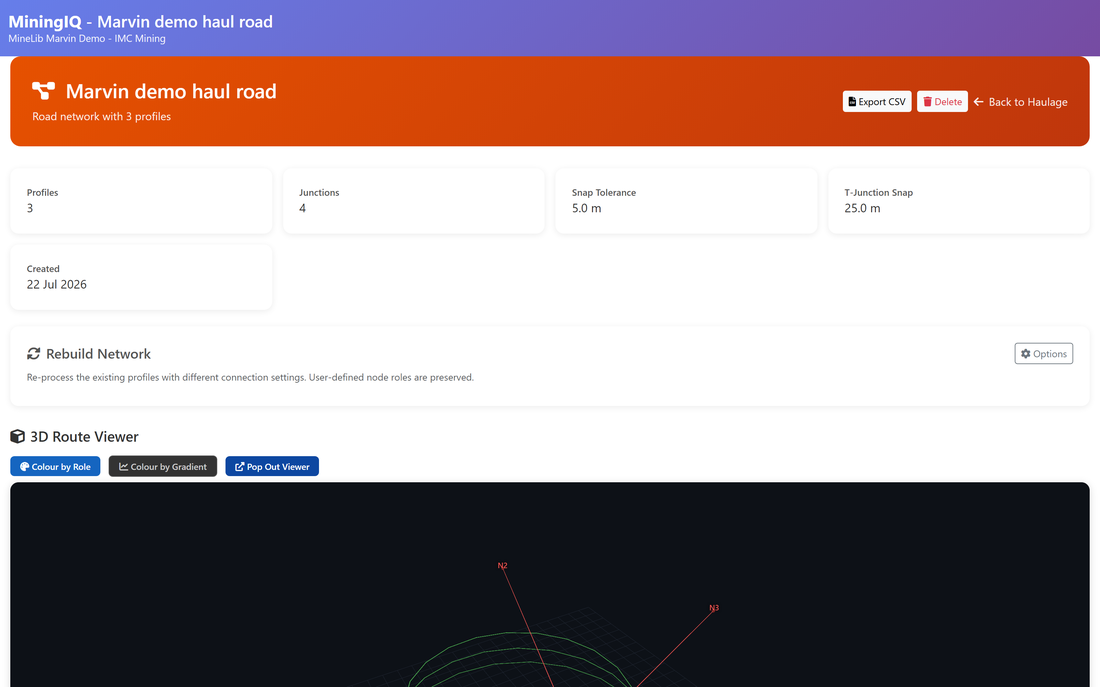
Instead of a calibrated flat efficiency factor, MiningIQ simulates trucks segment-by-segment with real kinematics and a discrete-event truck-shovel model — deriving fleet productivity from first principles.
See it
What it does
Kinematic physics
Segment-by-segment speed from rimpull/retarder curves, road-class resistance and caps, cornering and anticipatory braking.
Discrete-event truck-shovel
A SimPy model where shovels and dumps are finite resources — so real queuing and road bunching emerge.
Stochastic + breakdowns
Triangular load/spot/dump times, optional exponential-MTBF breakdowns, staggered starts and least-queue dispatch.
IMC delay model
Lost Time / Work Delay / Down Time classes populated from the MineCost roster.
Derives the efficiency factor
The effective 'SPRY factor' is computed from physics + queuing per source, bench, destination and truck.
Fleet sizing
Per-truck and per-shovel utilisation, queue and congestion diagnostics, and fleet optimisation.
How it works — the engineeringTechnical detail
SimPy discrete-event simulation over deterministic travel times from a kinematic forward pass; rimpull/retarder interpolation; NetworkX routing; JSON-cached road-network and haul-profile data. Ties to a MineCost scenario for roster hours and to FlowOpt block models.
haulage/services/ · des_engine · physics · network · fleet_scheduler · Haulage_sims/